<?xml version="1.0" encoding="utf-8"?>
<feed xmlns="http://www.w3.org/2005/Atom">
  <title>Etienne.co</title>
  <subtitle>Leading product design at Europe's leading AI defence company. Thinking out loud about technology, Europe, and how things get built.</subtitle>
  <link href="https://etienne.co/feed.xml" rel="self"/>
  <link href="https://etienne.co"/>
  <updated>2026-06-29T00:00:00Z</updated>
  <id>https://etienne.co/</id>
  <author>
    <name>Etienne Servant</name>
  </author>
  <entry>
    <title>What Designers Are Actually Talking About Now</title>
    <link href="https://etienne.co/writing/what-designers-are-actually-talking-about-now/"/>
    <updated>2026-06-29T00:00:00Z</updated>
    <id>https://etienne.co/writing/what-designers-are-actually-talking-about-now/</id>
    <content type="html"><![CDATA[<p>Next week, our Product Design team is converging from across Europe for a full day — going deep on a handful of topics that will define how we work in the coming months.</p>
<p>After putting the agenda together, I found myself scrolling back through notes accumulated over the years from offsites at previous companies. The recurring themes are surprisingly consistent: what does good look like, how do we track design quality, how do we align on execution standards across teams.</p>
<p>There was a lot of energy spent on design craft — making sure everyone had the same bar, that requests were well-scoped, that the cost of design work was understood and justified. Important work. But fundamentally, we were talking about outputs, execution — deliverables, pixels, components.</p>
<p>What's interesting is that the questions on next week's agenda are different. More fundamental, more focused on the reasoning behind the output:</p>
<ul>
<li>How do you design for AI agents?</li>
<li>How do you deliver high-quality UX when AI can generate interfaces on demand?</li>
<li>How should design career frameworks evolve when AI handles more of the execution?</li>
</ul>
<p>A couple of years ago, none of these were real questions. A year ago, they were on the horizon. Today they're central to our work.</p>
<p>Here's what we're spending the day on:</p>
<ol>
<li>
<p>0900 CET - <strong>AI Agents UX</strong> — A show &amp; tell of real prototypes across the team, benchmarked against the best agent UX patterns out there. What's working, where operators hit friction, what's worth keeping.</p>
</li>
<li>
<p>1100 CET - <strong>Product Design Levels</strong> — We adopted career levels a while back. AI-assisted design is changing what the job actually is. Time to check if they still hold.</p>
</li>
<li>
<p>1400 CET - <strong>Product Design Principles</strong> — What makes a Helsing product feel like one? We're putting it in writing.</p>
</li>
<li>
<p>1600 CET - <strong>Product Design Skills for LLMs</strong> — Building the LLM Skills that generate on-brand, quality-controlled UIs, grounded in the principles we define earlier that day. Setting the guardrails before we need them.</p>
</li>
</ol>
<p>Wonder what we'll be talking about at the next one.</p>
]]></content>
  </entry>
  <entry>
    <title>The Disappearance of the Manager</title>
    <link href="https://etienne.co/writing/the-disappearance-of-the-manager/"/>
    <updated>2026-06-10T00:00:00Z</updated>
    <id>https://etienne.co/writing/the-disappearance-of-the-manager/</id>
    <content type="html"><![CDATA[<p>The standard career progression in tech has a strange habit of pulling you away from the craft.</p>
<p>Like many people in tech, I started my career as an individual contributor. I was a Product Designer, getting my hands dirty, directly shaping products, and feeling the immediate impact of my decisions.</p>
<p>But as the startups I worked for grew and the industry matured, I took what seemed like the natural next step. I moved into management, eventually leading product design departments across several startups.</p>
<p>And as I climbed that ladder, my relationship with the work shifted. Building the product was still part of my job, but it took a much smaller slice of my attention. My focus moved toward the longer-term vision—and on building the organization so other people could do the day-to-day building.</p>
<p>My days became consumed by the machinery of orchestration. I was managing roadmaps, resolving alignment friction, and designing organizational structures so other people could build. I became a facilitator. A path-clearer. An orchestrator.</p>
<p>My direct, day-to-day impact felt more distant. Instead of shaping every detail of the interface, I was orchestrating other people’s impact.</p>
<p>For a long time, this felt like the most high-leverage thing I could do. In a hyper-specialized, highly fragmented industry, shipping software was incredibly hard. It required dozens of specialized roles—researchers, visual designers, frontend engineers, backend engineers, product managers—and a massive amount of communication overhead to keep them aligned. The manager was the human glue holding the fragmented pieces together.</p>
<p>We were necessary because the system was inefficient.</p>
<p>For a while, I thought the only way out of this trap was to distance myself from the tech industry entirely. I started trying to launch new ventures by myself, looking into smaller, highly focused setups to recapture that high level of agency and impact. I’d convinced myself that I simply wasn’t a fit for a scaling, mature company anymore—that I had to carve out my own quiet corner just to enjoy the work.</p>
<p>Then, I joined Helsing.</p>
<p>Suddenly, I found myself in a high-agency team with a surreal density of talent—operating inside a <a href="https://etienne.co/writing/collective-reality-distortion-field/">collective reality distortion field</a>. We didn’t hide behind committees, alignment slides, or layered management. When you put exceptionally capable people in a room and let them own their work end-to-end, the overhead of coordination evaporates. You realize that managers who exist to run processes are no longer facilitators—they are friction.</p>
<p>And when LLMs arrived, they made this transition irreversible.</p>
<p>By erasing the technical and production barriers that used to force people into narrow specializations, LLMs gave every builder an infinite department of execution. A single designer can now conceive an idea, model the behavior, design the interface, and write the code in days.</p>
<p>And as the team's agency grows, the manager's role begins to dissolve.</p>
<p>If a builder can self-direct, prototype, and validate their ideas in days, they don't need an orchestrator to coordinate handoffs. They don't need a head of department to manage a rigid, top-down roadmap, because the roadmap is being discovered in real time through working code.</p>
<p>When you give exceptionally capable people this level of individual agency, traditional management becomes a bottleneck. They don't need someone managing their hours or their tickets. They just need a clear compass and an unyielding standard of quality.</p>
<p>This leaves the traditional middle manager—the pure orchestrator who lives in meetings, manages roadmaps, and reviews specs—in a strange position. The administrative friction they were hired to manage is vanishing. The translation layer they occupied is compressing.</p>
<p>I don't think this means leadership is dead. But it means the nature of leadership has inverted.</p>
<p>We are moving away from the era of the &quot;facilitator manager&quot; and back to the era of the &quot;builder leader.&quot; You can't just manage the process of building anymore; you have to hold the taste, set the quality bar, and build alongside the team. You lead by setting the vision through proof of work, not by running the sprint planning meeting.</p>
<p>Looking back at my time managing design departments, I realize how much energy we spent on the administrative choreography of product development. We built elaborate processes to protect ourselves from the cost of building the wrong thing.</p>
<p>Now that the cost of building has collapsed, the orchestration layer is dissolving. We can afford to stop managing the process and start making things real again.</p>
<p>For managers who secretly missed the raw joy of building, that is the best news in a decade.</p>
]]></content>
  </entry>
  <entry>
    <title>Collective Reality Distortion Field</title>
    <link href="https://etienne.co/writing/collective-reality-distortion-field/"/>
    <updated>2026-03-14T00:00:00Z</updated>
    <id>https://etienne.co/writing/collective-reality-distortion-field/</id>
    <content type="html"><![CDATA[<p>If you asked me why I joined Helsing four years ago, I would have talked about the mission. I’d have told you about the importance of protecting the sovereignty of European democracies.</p>
<p>A couple of years later, I’d have talked about the craft. The fascinating design and engineering complexity of physical-AI systems and high-stakes user interfaces.</p>
<p>Today, I mostly talk about the team, why this group of people makes this place special—and a strange phenomenon we’ve built here: a collective &quot;reality distortion field.&quot;</p>
<p>When you look at the systems we are building—from autonomous fighter jets and AI strike drones to underwater autonomous vehicles and more—by all traditional standards, each should require hundreds of people, layers of committees, and years of &quot;requirements gathering&quot; and &quot;alignment&quot;.</p>
<p>Then you get here, and you watch a handful of people build and ship in a couple of weeks—work you’ve been taught should take months or years.</p>
<p>How does something like that actually happen?</p>
<p>I think there is a simple, mechanical reason for it. It isn't just about &quot;hiring smart people&quot;—most tech companies do that and still drown in inertia. It happens when you combine three specific things: surreal talent density, extreme individual agency, and a culture of raw, high-substance curiosity grounded in first principles.</p>
<p>No matter how niche, complex, or obscure the topic is — you are always exactly one Slack message away from someone who deeply understands it. The distance between a hard question and a frontier-level answer is virtually zero.</p>
<p>I find myself reading my inbox, Slack, and Confluence pages with the same excitement I had reading Hacker News 15 years ago—you are reading people writing deeply about the raw truth of how things work, charting entirely unknown territories, and demystifying things you once thought were far too difficult to understand.</p>
<p>When you put exceptionally capable people in a room under those conditions and let them own things end-to-end, you don't just work faster—you change what the team believes is possible, and collapse traditional timelines.</p>
<p>I remember reading Steve Jobs’ biography many years ago, wondering what his &quot;reality distortion field&quot; must have actually felt like. It sounded like some kind of black magic—one charismatic leader convincing a room that the impossible was simple, just by force of will.</p>
<p>But what I'm experiencing here is different. It’s still a reality distortion field, but it isn’t being imposed from the top down. It is a collective property of the team itself.</p>
<p>This collective distortion field isn't just a nice cultural perk; it’s the entire game. It’s our ultimate unfair advantage.</p>
<p>You stop saying <em>&quot;that will take two quarters, 20-person teams, and deprioritizing X, Y, and Z,&quot;</em> and start saying <em>&quot;let's take this handful of people, have a simulation running by next week, and make it fly within three months.&quot;</em> And because you are surrounded by people who believe they can do it—and who have the raw capability to back it up—you do.</p>
]]></content>
  </entry>
  <entry>
    <title>Memories from Ukraine</title>
    <link href="https://etienne.co/writing/notes-from-ukraine/"/>
    <updated>2025-12-09T00:00:00Z</updated>
    <id>https://etienne.co/writing/notes-from-ukraine/</id>
    <content type="html"><![CDATA[<p><img src="/img/image.jpg" alt="alt text" title="Title" loading="lazy"></p>
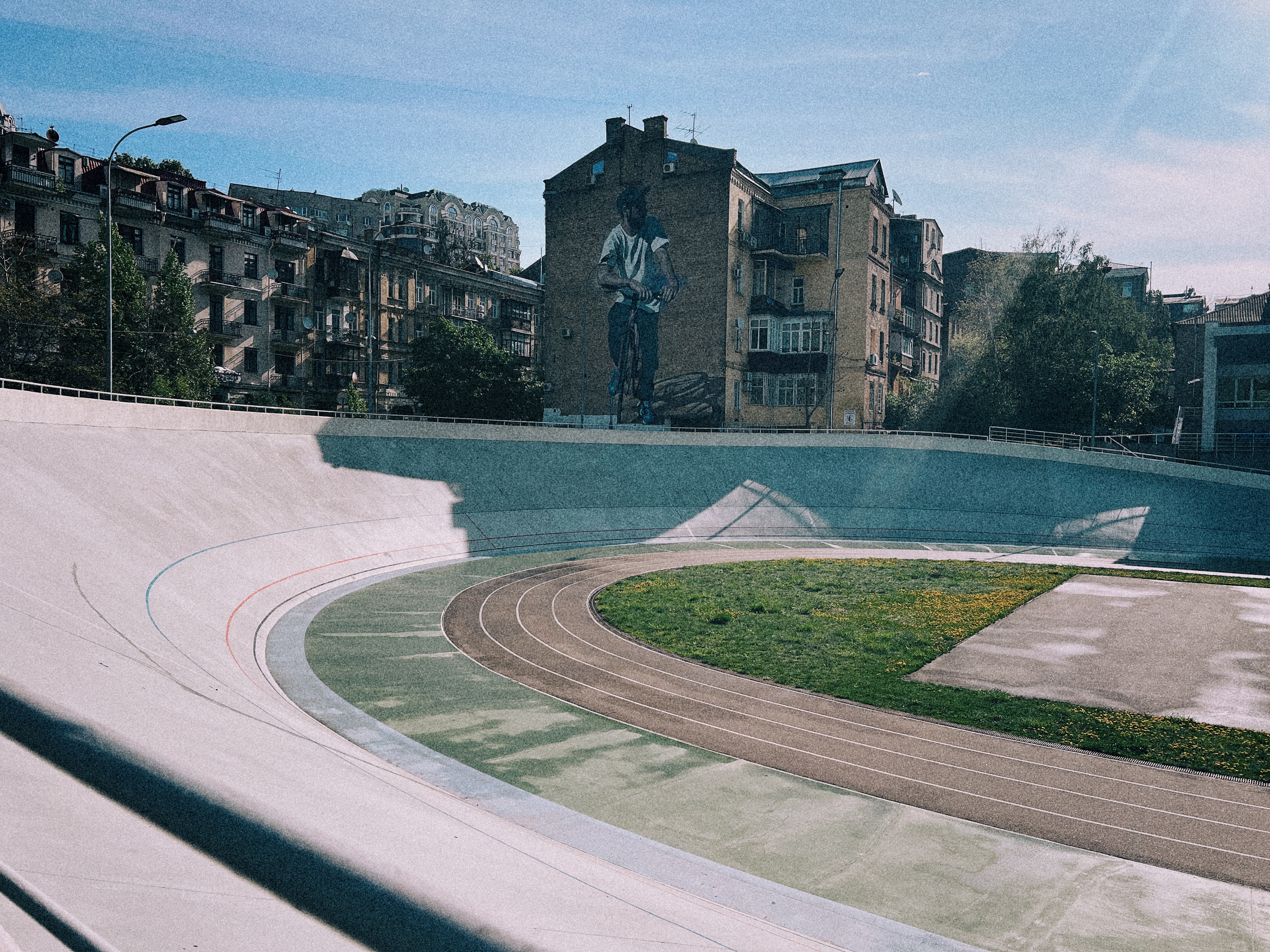
<p>On the long train from Lviv to Kyiv, I did what I always do on long journeys: opened Strava and  fell down a rabbit hole of cycling routes.</p>
<p>I found the Ukrainian cycling community. Men in their 20s and 30s — same age as me, same kit, same obsessive documentation of climbs and intervals. I followed a dozen of them. Traced their routes on the map. Added some to a list of roads I want to ride when peace returns.</p>
<p>Their ride logs are irregular. Weeks of nothing, then a cluster of activities, then nothing again. Brief rotations away from the front.</p>
<div class="inline-gallery"><figure class="gallery-item"><img src="/img/_(1_of_2).jpg" alt="" loading="lazy"></figure><figure class="gallery-item"><img src="/img/_(2_of_2).jpg" alt="" loading="lazy"></figure></div>
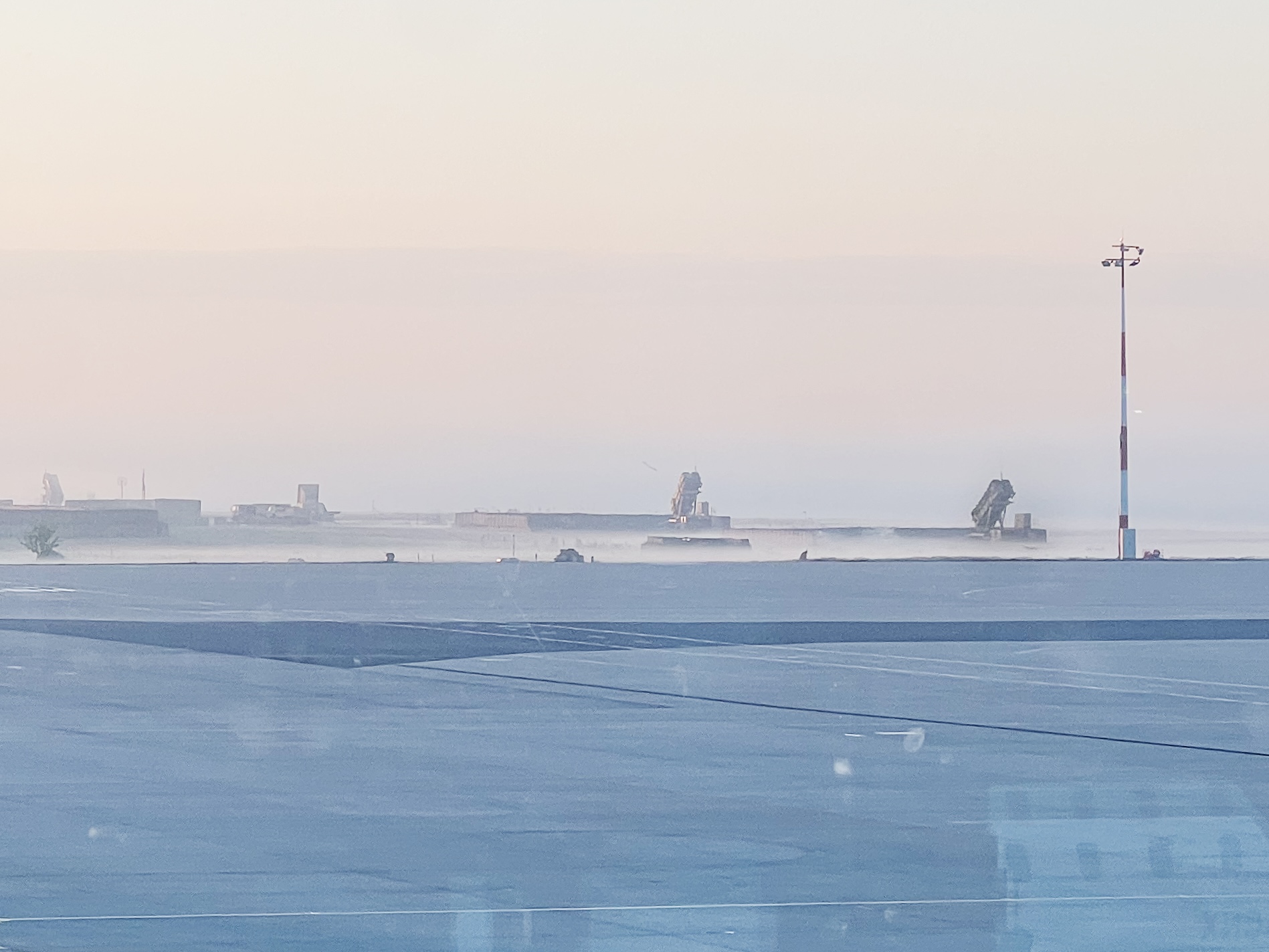
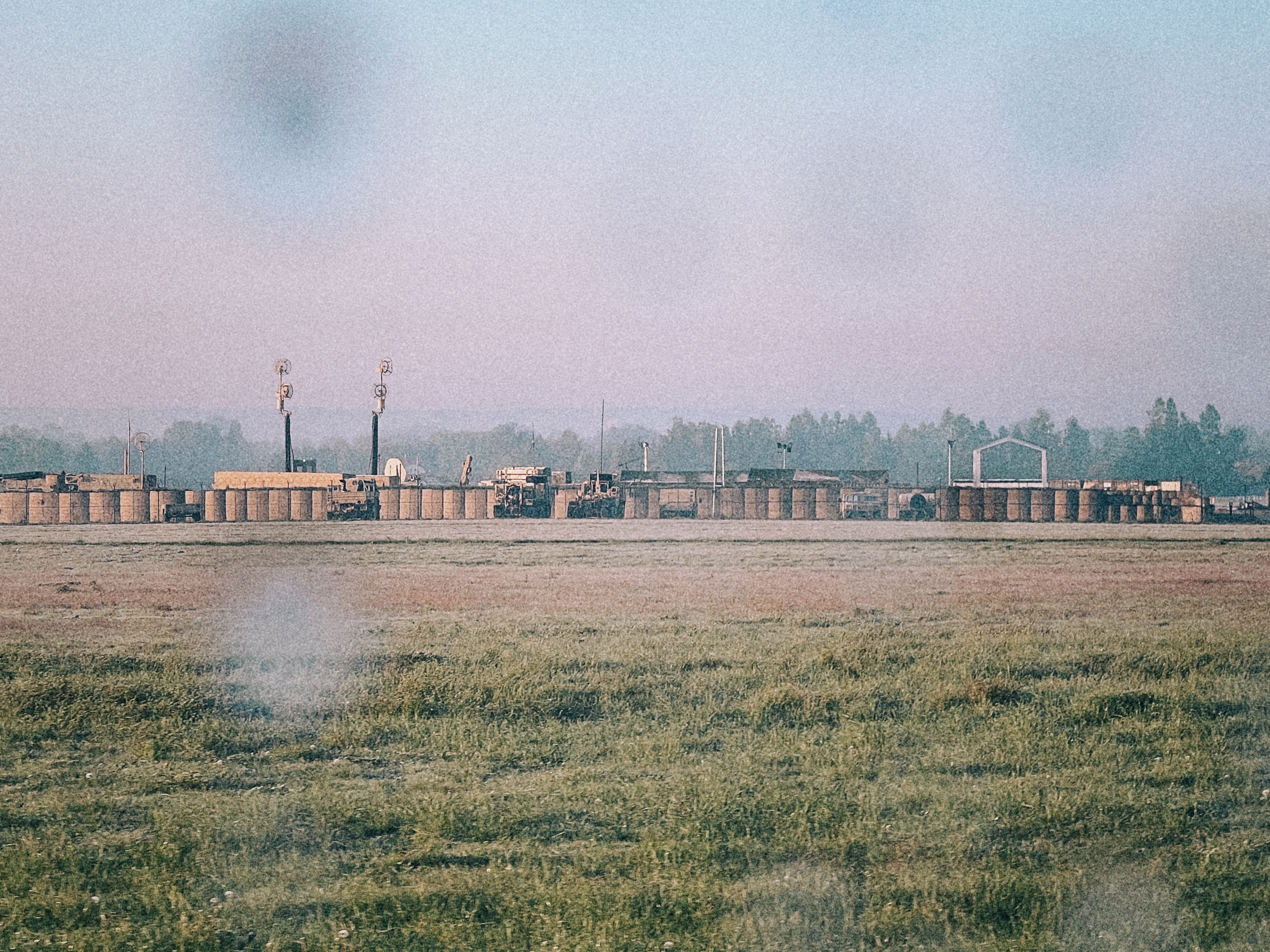
<p>I had arrived through Poland the night before, on a budget airliner — the kind built for stag weekends and cheap sun. Patriot systems visible on the tarmac, military equipment waiting for transfer. The scale of what it takes to keep a country fighting, laid out in hardware. The border crossing itself was mundane. Much faster than CDG. A stamp, and I was in.</p>
<div class="inline-gallery"><figure class="gallery-item"><img src="/img/_(1_of_4).jpg" alt="" loading="lazy"></figure><figure class="gallery-item"><img src="/img/_(2_of_4).jpg" alt="" loading="lazy"></figure><figure class="gallery-item"><img src="/img/_(3_of_4).jpg" alt="" loading="lazy"></figure><figure class="gallery-item"><img src="/img/_(4_of_4).jpg" alt="" loading="lazy"></figure></div>
<p>Ukraine looks like Europe. Green fields, commercial strips, shops you'd recognise. That familiarity is what makes it hard to hold. Kyiv has great restaurants, great coffee, people going about their lives. During the day, the war is mostly invisible. At night it isn't. Air raid alerts become routine quickly. You learn the shelter locations, pack a bag before bed — clothes, battery, water — and sleep knowing you might be woken and moved underground. You carry on.</p>
<p><img src="/img/image-2.jpg" alt="alt text" title="Title" loading="lazy"></p>
<div class="inline-gallery"><figure class="gallery-item"><img src="/img/_(1_of_3)-2.jpg" alt="" loading="lazy"></figure><figure class="gallery-item"><img src="/img/_(2_of_3)-2.jpg" alt="" loading="lazy"></figure></div>
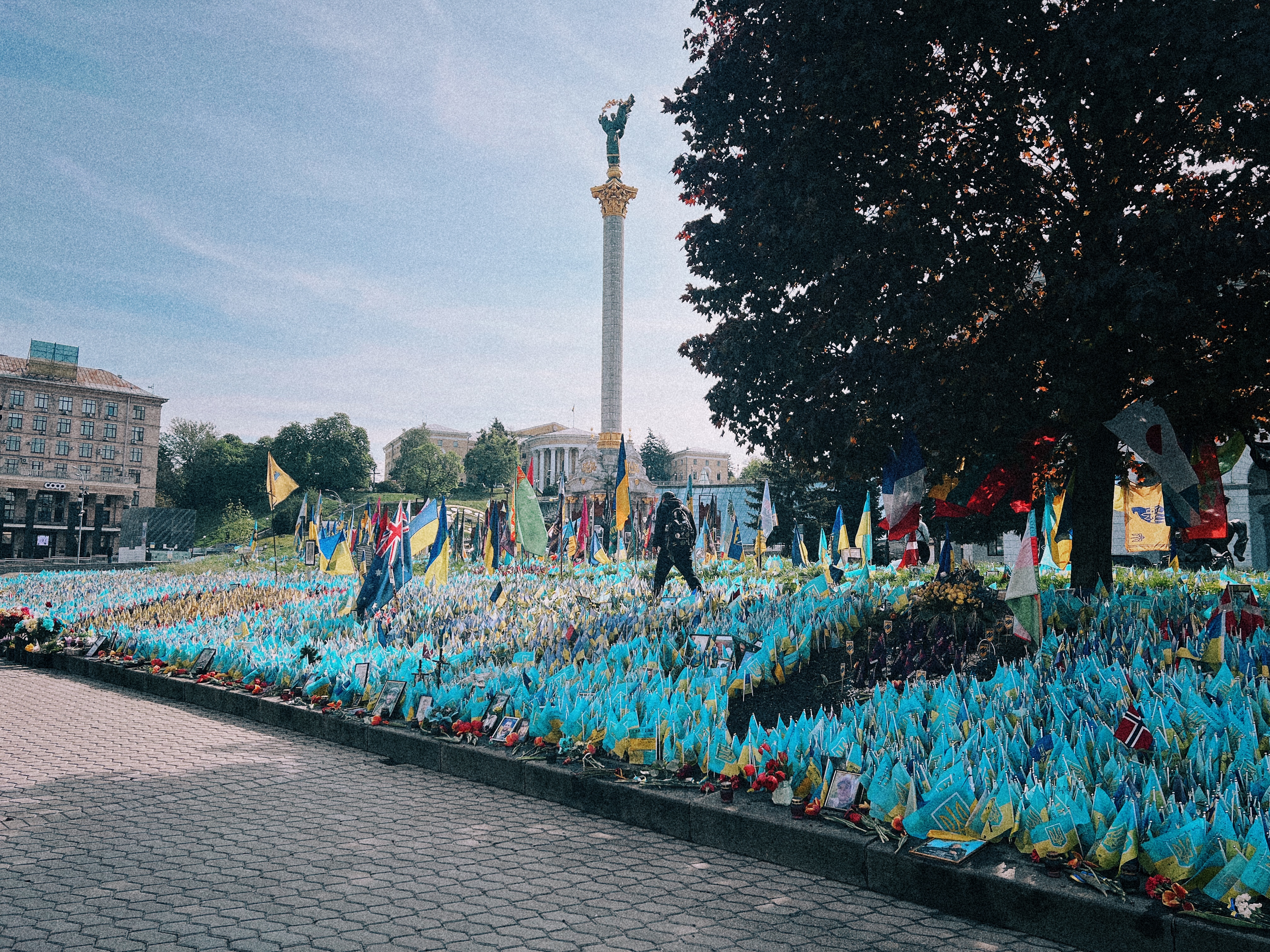
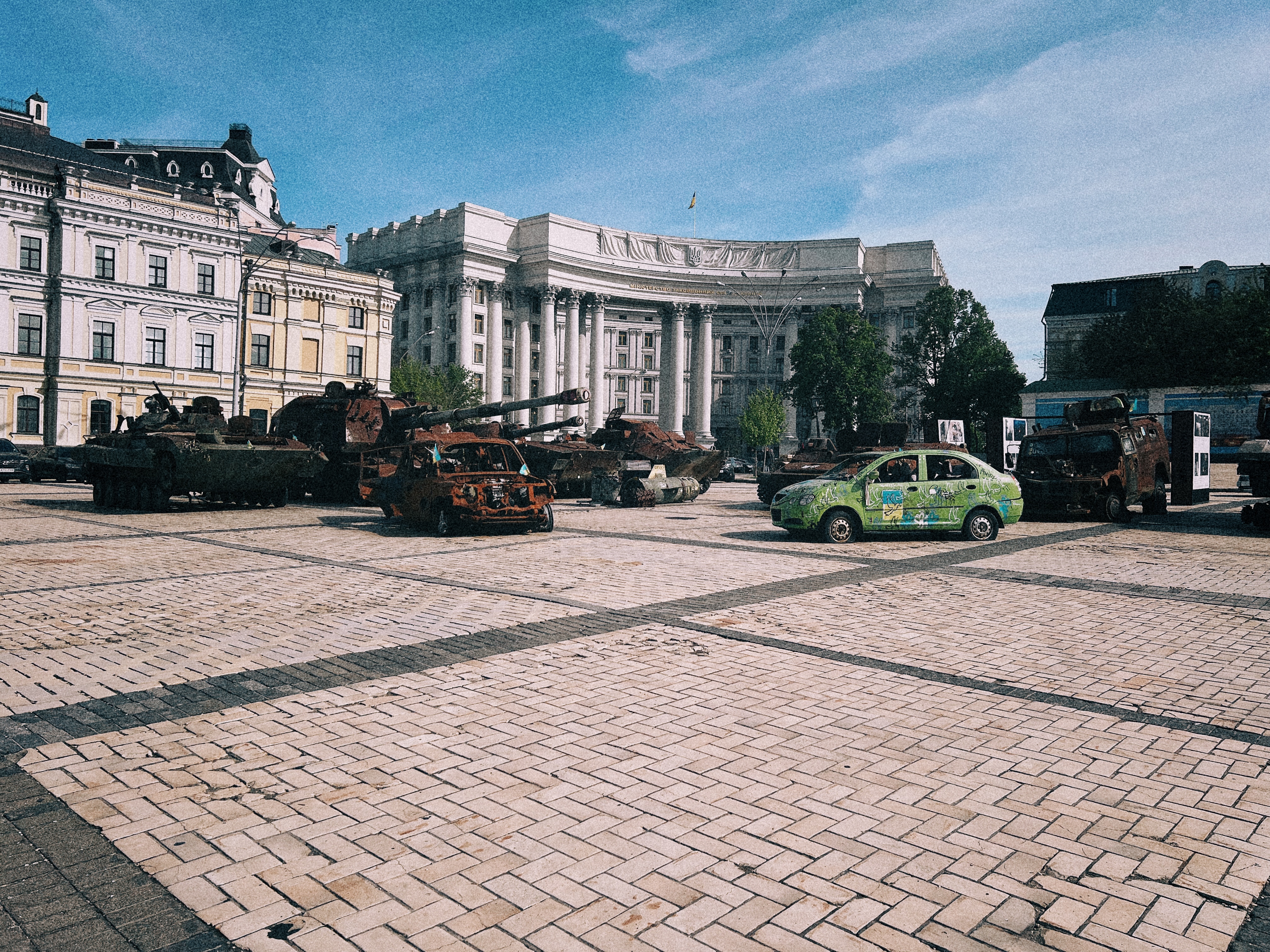
<p>At Mykhailivska Square, captured Russian vehicles sit on public display. Trophies. Evidence. At Maïdan Nezalezhnosti, I stopped for a long time. I had followed the 2014 uprising online, watching it unfold tweet by tweet from a safe distance. Standing on that ground was something I hadn't anticipated emotionally. Thousands of small flags in the grass, each one a soldier. They move in the wind. The uprising I watched online wasn't a conclusion — it was a chapter.</p>
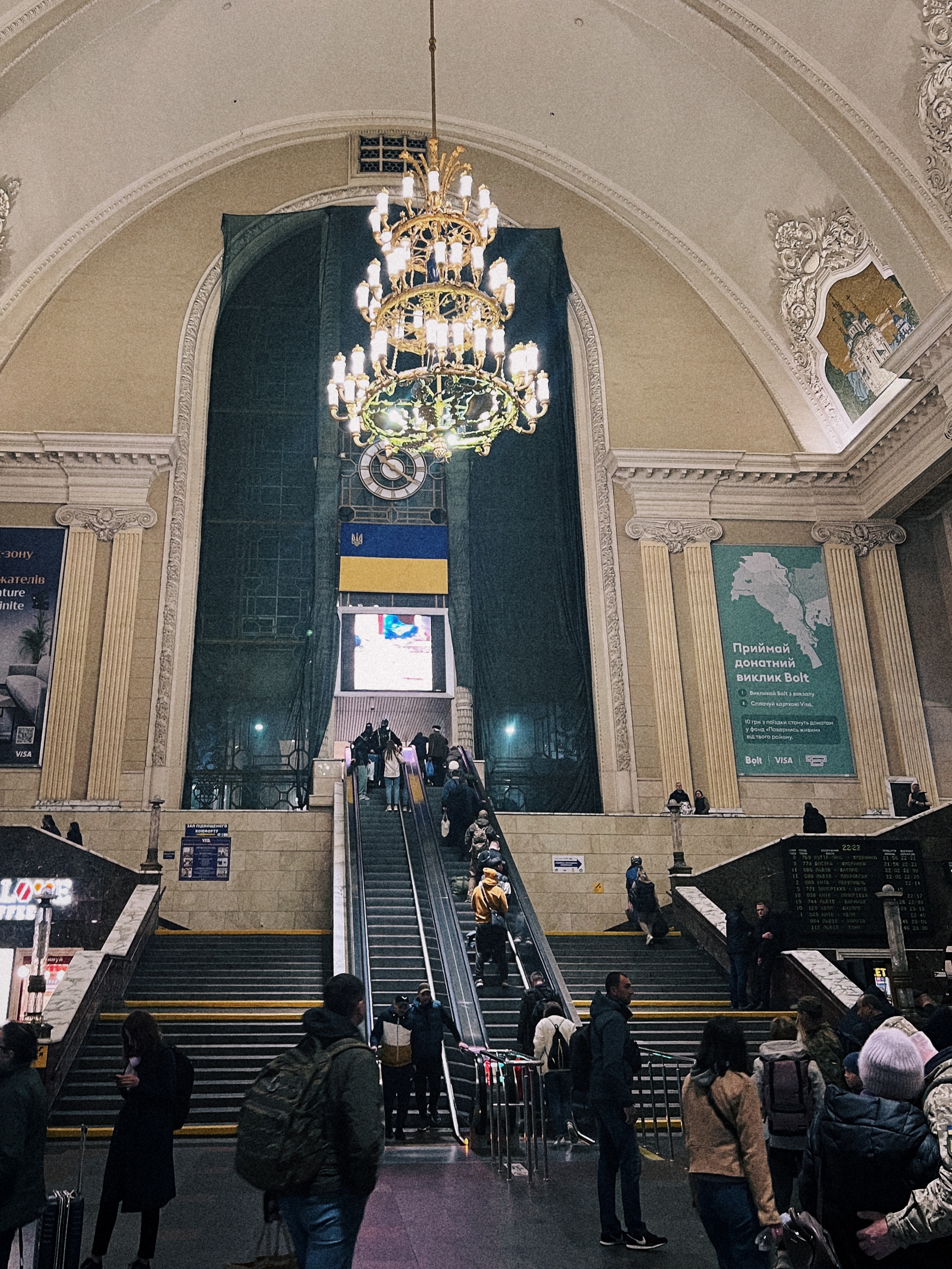
<p>The scars you don't see immediately are demographic. Walking the streets, something felt off before I could name it. Women, children, young adults everywhere — and fewer men in their 30s, 40s, 50s. A society-shaped hole where a generation of men would normally be. At the train station, I saw families sending soldiers back to the front. The air thick with a specific kind of love.</p>
<p><img src="/img/_(1_of_2)-2.jpg" alt="" loading="lazy"></p>
<p>One image I won't lose: a young girl at the bottom of an escalator, watching her father ascend. She was old enough to understand what goodbye might mean here. She was physically sick from the weight of it, her mother holding a bag for her.</p>
<p>Recently, one of the cyclists I followed on Strava was killed in action. A fellow rider who won't ride again. A fellow father who won't come home to his daughter.</p>
<p>I carried back home some memories. The flags in the grass. The goodbyes on this escalator. The irregular ride logs that will eventually stop updating.</p>
]]></content>
  </entry>
  <entry>
    <title>The Renaissance of Building Product</title>
    <link href="https://etienne.co/writing/the-renaissance-of-building-product/"/>
    <updated>2025-10-23T00:00:00Z</updated>
    <id>https://etienne.co/writing/the-renaissance-of-building-product/</id>
    <content type="html"><![CDATA[<p>There is a feeling I haven’t felt in over a decade.</p>
<p>If you built digital products in the late 2000s or the early 2010s, you probably know the feeling I'm talking about. Back then, the lines between designing and building were thin. You were a full-stack builder. You didn’t need a massive team, millions in funding, or weeks of alignment meetings to bring an ambitious, crazy idea to life. You just sat down, wrote the code, and shipped it.</p>
<p>But after that, the complexity exploded. Suddenly, building required bigger teams, heavier funding, and endless layers of organization. It became almost impossible to create anything transformative on your own. As the industry matured and hyper-specialized, we drifted away from being builders of product. We became managers of alignment, curators of static Figma snapshots, and authors of requirements pages rather than builders of the real thing. It was still possible to build something alone, but the friction was immense.</p>
<p>Lately, though, that old builder feeling is back. It feels like a genuine renaissance.</p>
<p>Thanks to LLMs, we are reclaiming a level of individual agency and impact that seemed lost. But this shift isn't just about speed, or bypassing the engineering queue.</p>
<p>The real shift is that we are no longer looking at the surface of a product. Instead of building pixel copies of a few key moments—which, until now, were the only proxies we had—we can go deeper and think about how the system actually works. We build the system itself, and then overlay the interface on top.</p>
<p>In the hyper-specialized era, having a new idea meant paying an immense tax on curiosity. You had to write pages of product specifications, build slide decks to explain the vision, and spend weeks in meetings trying to align stakeholders. You had to justify the cost of simply trying.</p>
<p>By the time you reached the level of consensus needed to write the first line of code, the original spark was already diluted, or the initiative was dead on arrival.</p>
<p>Today, that barrier has vanished.</p>
<p>When you can build a dynamic, behavior-driven model in a couple of days on your own—something fueled by realistic data rather than static assumptions—you don't need to ask for permission. You don't need to write a PRD or pitch a slide deck. You just hand people a working experience that they can interact with, feel, and learn from.</p>
<p>A working prototype collapses debate. In meetings, instead of debating abstract assumptions about how an interface might behave, you just run the code. The conversation shifts from politics and persuasion to raw substance.</p>
<p>This is a fundamental shift in agency. When the distance between a raw idea and a working reality is virtually zero, the balance of power returns to the builders. We can stop looking at the surface, stop managing the alignment loop, and go back to what we did best: making things real.</p>
]]></content>
  </entry>
</feed>